

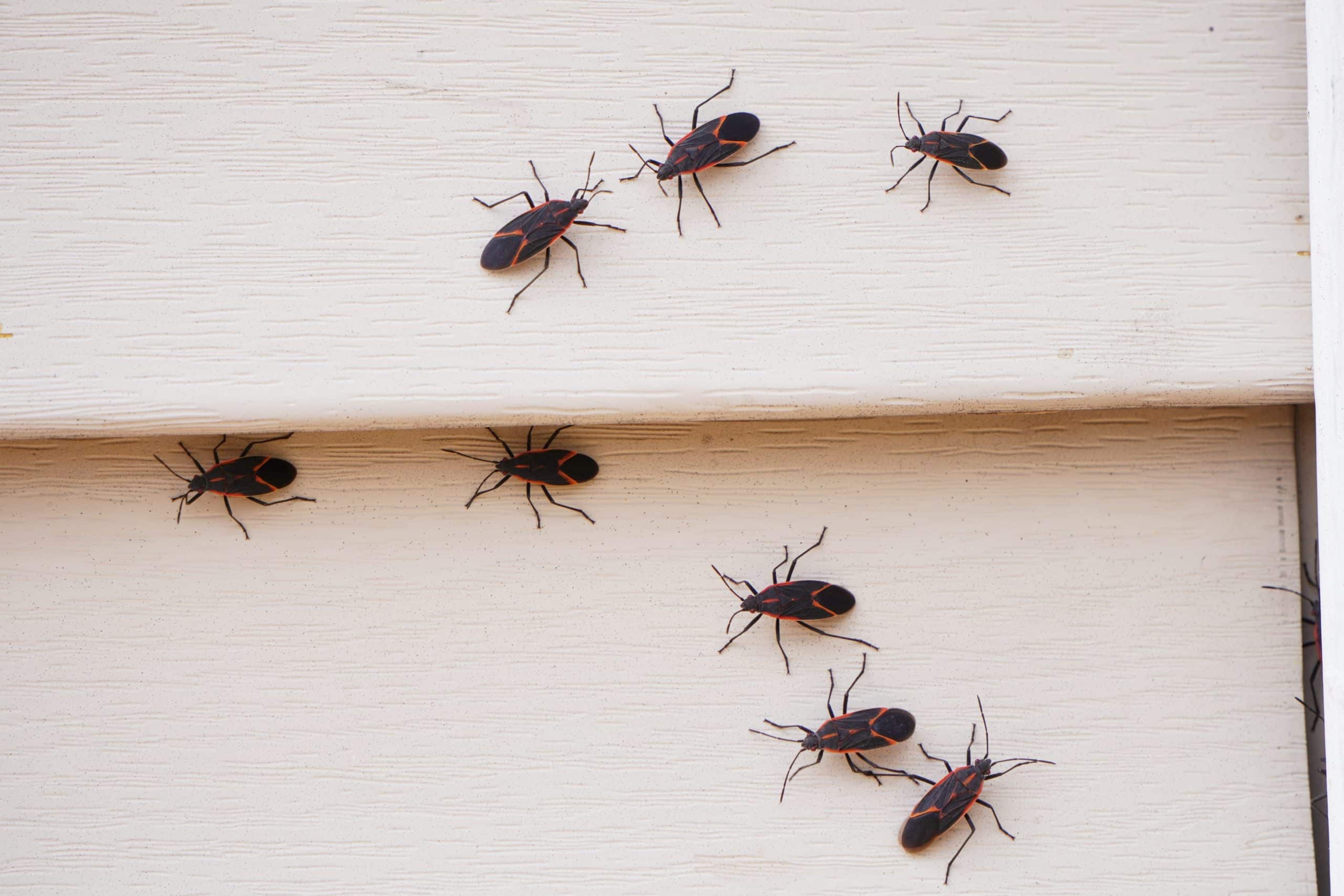
You walk past the sunny side of your home and see black and red bugs packed around the siding, windows, and roofline. They may not have been there that morning. Once the afternoon sun warms the wall, the cluster seems to appear all at once.
A box elder bug uses that warm surface before winter. South-facing and west-facing walls stay warmer than shaded parts of the house, so the bugs land there and begin searching for cracks around siding, trim, vents, and roof edges.
In this guide, you will learn why boxelder bugs gather on your house, how they get inside, and what to do before the problem becomes an indoor boxelder bug infestation.
Why Boxelder Bugs Choose Sunny Walls
Boxelder bugs become less active as outdoor temperatures fall. Sun-warmed siding, brick, and stucco give them enough heat to keep moving on a cool afternoon. Southern walls receive sunlight for much of the day. Western walls collect strong afternoon heat. Those exposures become common gathering areas each fall.
The wall also places the insects close to shelter. Window trim, siding joints, soffits, roof edges, and utility openings may contain narrow spaces where they can hide.
Penn State Extension reports that boxelder bugs collect on the sunny sides of buildings, trees, and rocks during fall. The behavior is tied to warmth and the search for winter shelter, not feeding on the house.
Why One Wall Has More Bugs Than Another
Sun exposure is only part of the answer. The wall with the most bugs often has more entry points too.
A western wall with loose siding, failed sealant, or a gap around a cable line gives the insects a warm landing place and a short route into the structure. A shaded wall with tight construction may attract far fewer.
Height also affects where they gather. Upper walls, soffits, and roof edges are easy for flying insects to locate. These areas may stay warm after lower sections of the house begin cooling.
| Exterior Condition | Why It Matters |
| South-facing wall | Receives long periods of fall sunlight |
| West-facing wall | Holds strong afternoon heat |
| Brick or masonry | Stores heat after the air begins cooling |
| Loose siding | Creates narrow shelter behind the surface |
| Aging window trim | May contain cracks or failed sealant |
| Soffits and roof edges | Can lead toward attic spaces |
| Pipe and cable openings | Often leave gaps around the penetration |
| Tall exposed wall | Gives flying bugs a clear landing area |
Why the Cluster Appears So Fast
Several cool nights can push adult boxelder bugs to begin searching for winter shelter. A bright afternoon then warms the wall enough for them to move again.
Many adults respond to the same conditions at the same time. That is why a wall can look clear in the morning and crowded later that day.
They are not hatching on the house. The warmer surface makes existing adults more active and easier to see.
How to Identify Boxelder Bugs
Adult boxelder bugs have narrow black or dark brown bodies. Thin red or orange lines run along the wings and behind the head. When the wings are folded, the markings form an X across the back.
Young boxelder bugs look different. Their bodies are bright red, and their darker wing pads become more visible as they grow.
Homeowners sometimes confuse them with stink bugs, beetles, or milkweed bugs. Boxelder bugs are slimmer than stink bugs, and their red wing lines are a useful clue.
| Feature | What You Will See |
| Adult length | About 1/2 inch |
| Newly hatched nymph length | About 1/16 inch |
| Adult color | Black or dark brown |
| Adult markings | Thin red or orange lines |
| Nymph color | Bright red with darker markings |
| Body shape | Narrow and slightly flattened |
| Resting wings | X-shaped pattern across the back |
| Outdoor gathering areas | Sunny walls, foundations, rocks, and tree trunks |
| Indoor locations | Windows, ceilings, attics, and wall spaces |
The University of Minnesota Extension boxelder bug resource reports that adults measure about one-half inch and newly hatched nymphs about one-sixteenth inch. It also states that adults may fly as far as two miles while searching for shelter. That distance explains why boxelder bugs can reach your property even when no boxelder tree grows in your yard.
What Boxelder Bugs Do During Fall and Winter
Boxelder bugs spend the warmer months around trees, shrubs, and ground cover. They feed most often on seeds from female boxelder trees. Some maple and ash trees may also support them.
By late summer, the adults begin leaving their feeding areas. They start looking for a dry, protected place where they can remain through winter.
From Trees to Buildings
Cool nights begin the seasonal movement. Warm afternoons make it visible.
The insects fly toward houses, sheds, fences, tree trunks, and rock surfaces. After reaching a building, they rest on the warm exterior and begin checking nearby gaps.
A cold or cloudy day may stop most visible activity. When the sun returns, the bugs start moving again. That change can make the population look larger from one day to the next.
How Boxelder Bugs Get Inside
Boxelder bugs can use small gaps around siding, window frames, doors, foundations, shingles, soffits, and utility lines. Damaged screens and worn garage-door seals can provide more routes.
In its boxelder bug publication, Purdue Extension lists foundations, windows, doors, siding, and shingles among the common entry areas used by boxelder bugs in fall. Some bugs remain behind siding. Others move into wall spaces, attics, or gaps around windows. Once cold weather settles in, most become inactive.
| Season | Typical Activity | What You May Notice |
| Spring | Adults leave winter shelter | Bugs near windows or exterior walls |
| Early summer | Eggs hatch and nymphs begin feeding | Small red bugs near trees and plants |
| Late summer | Nymphs mature | More adults around host trees |
| Early fall | Adults begin looking for shelter | Boxelder bugs on sunny walls |
| Late fall | Bugs enter cracks and voids | Activity near siding, windows, and rooflines |
| Winter | Adults remain mostly inactive | A few bugs during warm spells |
| Early spring | Adults move toward outdoor light | Bugs gathering near indoor windows |
Why They Show Up Indoors in Winter
A sunny winter day can warm one part of the wall enough to wake hidden bugs. Some move toward the heated interior instead of finding an outdoor exit.
That is why you may find boxelder bugs near windows, ceilings, or light fixtures in January or February. They are not breeding indoors. They entered during fall and became active when temperatures changed.
Do Boxelder Bugs Damage Your Home?
Boxelder bugs do not feed on wood, insulation, siding, wiring, furniture, clothing, or stored food. They are nuisance pests, not structural pests.
Their numbers create most of the concern. A large exterior cluster can look serious, and indoor activity may continue for months when many bugs enter wall spaces.
Stains and Odor
Boxelder bugs may leave dark spots on curtains, walls, windowsills, and other light surfaces. Crushing one can produce an unpleasant odor and a red or brown stain.
Use a vacuum indoors instead of pressing the insects against painted walls, fabric, or upholstery. Empty the contents outside after removal.
Indoor sprays may kill exposed bugs, but they do not reach insects hidden behind siding or inside wall voids.
Tree Damage
Boxelder bugs feed on seeds and soft plant tissue, but they seldom cause serious injury to a healthy tree. Large numbers on a trunk often look worse than the feeding damage.
Removing a mature boxelder tree is not a reliable first step. Adults may fly in from nearby yards, roadsides, parks, or wooded areas. Closing exterior entry points usually addresses the part of the problem that affects your home.
How to Keep Boxelder Bugs Out
The most useful prevention work happens before the insects settle behind siding. Start checking the exterior in late summer, especially along south-facing and west-facing walls.
Look for places where sunlight and openings overlap. A warm window with cracked sealant deserves more attention than a shaded section with tight construction.
Inspect and Repair Entry Points
Check for:
- Torn window screens
- Loose siding
- Worn door seals
- Foundation cracks
- Damaged soffits
- Gaps around utility lines
- Unprotected attic vents
- Failed sealant around windows
- Openings near roof joints
- Worn garage-door sweeps
Use a repair material suited to the opening. Narrow joints may need exterior-grade sealant. Larger spaces may require flashing, mesh, foam, or a building repair.
Do not fill brick weep holes or block working vents. These openings need covers that preserve drainage and airflow.
Match the Response to the Problem
| What You See | Best Next Step | Avoid |
| A few bugs on siding | Rinse or vacuum them away | Crushing them against the wall |
| Bugs around one window | Inspect the outside trim and seal gaps | Spraying curtains or indoor glass |
| Bugs entering below a door | Replace the sweep or weather stripping | Using towels as a permanent barrier |
| Activity near the roofline | Inspect soffits, vents, and siding joints | Climbing without proper equipment |
| Bugs inside one room | Vacuum them and check the matching exterior wall | Using indoor foggers |
| Heavy clusters every fall | Schedule an exterior inspection | Waiting until winter |
| Nearby boxelder tree | Monitor the tree and focus on exclusion | Removing it without confirming the source |
A stream of water can remove small outdoor groups. An outdoor vacuum may also work on dry siding or masonry.
Soap and water kill only the insects touched by the mixture. It does not stop new bugs from landing. Detergent may also mark painted surfaces or damage nearby plants.
Exterior boxelder bug control may help during heavy activity, but the work is most useful while the insects are still outside. Once they move into wall spaces, surface treatments cannot reach most of them.
Remove Indoor Bugs Cleanly
Use a vacuum around windows, ceilings, curtains, and baseboards. Empty the contents outdoors when you finish.
Track where the indoor activity occurs. The same room, window, or ceiling area may point toward an exterior opening that needs repair.
This step will not remove every hidden bug, but it limits staining and gives you better information for the next exterior inspection.
When Boxelder Bug Service Is Worth It
A few insects on an outside wall rarely justify a service call. The situation changes when clusters return every fall, bugs enter several rooms, or activity appears around rooflines you cannot inspect safely.
A recurring boxelder bug infestation often means the structure has several access points. Older siding, failed sealant, attic vents, utility penetrations, and roof joints may all contribute.
Visible bugs are only part of the issue. The harder job is finding the openings that allow an outdoor cluster to become an indoor problem. Professional service technicians can inspect the exterior based on where the bugs gather and where they are likely to move next. That includes windows, doors, eaves, soffits, vents, roof edges, utility lines, and the base of the home.
Stop the Fall Cluster Before It Reaches Your Walls
The bugs covering your sunny wall are showing you where the house is warm and where entry may be possible. Removing the cluster deals with what you can see. Inspecting and closing nearby gaps addresses what may happen next.
Professional boxelder bug control makes sense when the activity returns each year, spreads into several rooms, or occurs around high sections of the home. Those conditions often involve entry points that are hard to find or unsafe to reach without the right equipment.
Contact LaJaunie’s Pest Control to schedule service. We will inspect the exterior, identify likely pest entry points, and recommend the next step based on the conditions around your home.