
🐞 Free Pest & Termite Inspection* | Same-Day Service*🐞

Get Service TODAY!

Identifying Venomous Snakes in Baton Rouge Yards

venomous snake identification baton rouge

Most snakes found in Baton Rouge yards are harmless. The city sits in dense snake habitat: bayous, drainage canals, and wooded corridors support both venomous and nonvenomous species. Louisiana has 47 native snake species, and seven are venomous. For most homeowners, the two most likely to turn up in a yard are the cottonmouth (water moccasin) and the eastern copperhead. Knowing what each one looks like and how to tell them apart from the many harmless species nearby helps you respond correctly when you find one.

Key Takeaways

  • Louisiana has seven venomous snake species, but only the cottonmouth and copperhead are abundant statewide and commonly encountered near homes in the Baton Rouge area.
  • Body pattern and coloring are more reliable identification markers than head shape or eye pupils, which can look similar on nonvenomous species.
  • Timber rattlesnakes are native to Louisiana but are far more likely in heavily wooded rural areas than in suburban yards.
  • Coral snakes carry potent venom but spend most of their time underground and are rarely encountered in a typical residential yard.
  • If you spot a snake and aren’t certain what it is, give it space and contact a licensed wildlife control professional rather than trying to handle or kill it.

The Two Venomous Snakes Most Common in Baton Rouge Yards

Northern Cottonmouth (Water Moccasin)

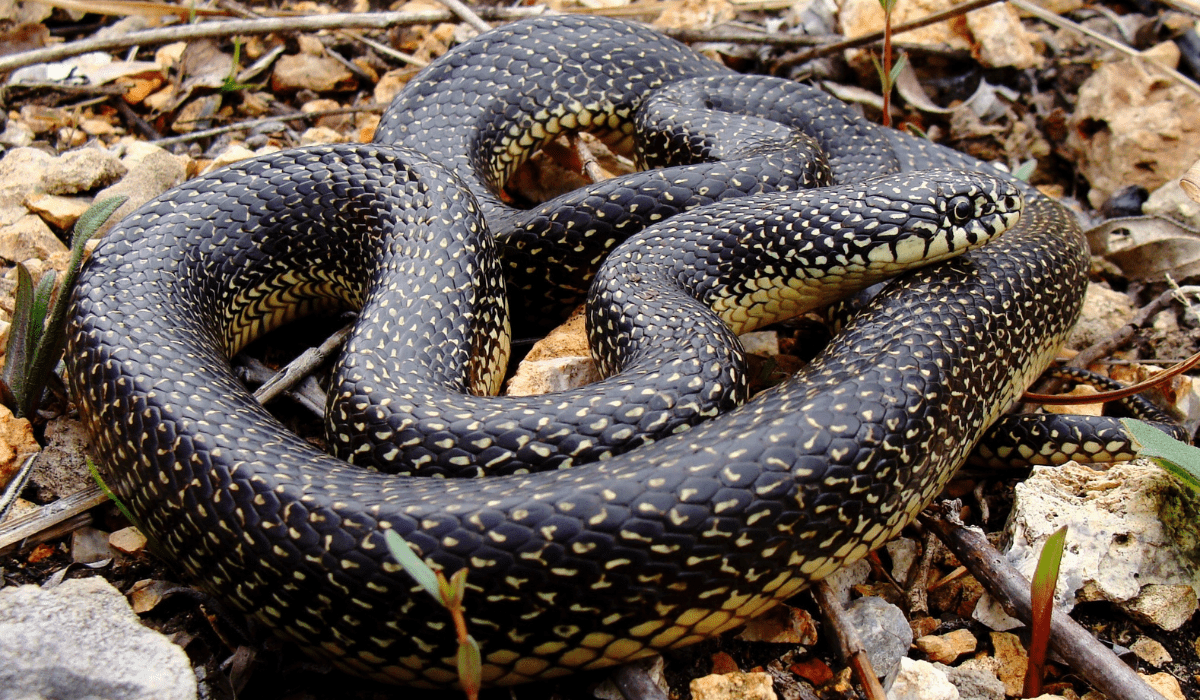
The cottonmouth is the venomous snake Baton Rouge homeowners are most likely to encounter. It thrives near water: bayous, drainage ditches, ponds, slow streams, and flooded areas. Baton Rouge has plenty of those. Adults are dark tan, brown, or nearly black, with darker crossbands that fade on older individuals and can disappear almost entirely. They range from 15 to 55 inches long.

The behavior that gives this snake its name is also the most reliable field identifier: when threatened, it coils, holds its ground, and opens its mouth wide to reveal a bright white interior against its dark body. This is a defensive display, not aggression. Despite its reputation, the cottonmouth retreats when it has a clear exit.

In Louisiana, the nonvenomous banded water snake and the diamond-backed water snake are regularly mistaken for the cottonmouth. Both flatten their heads and mimic defensive postures when frightened. If you’re not sure, don’t close the distance.

Eastern Copperhead

The eastern copperhead is well-known throughout Louisiana, though it is less common in fully developed suburban areas than along wooded edges and rural margins. It ranges from 14 to 45 inches, beige to pale gray with a dull pink or orange tint and darker brown, hourglass-shaped crossbands. Those bands are narrower at the center of the back and wider on the sides. Viewed from above, the hourglass shape is the clearest ID marker.

Young copperheads have a bright yellow-green tail tip that fades as they mature. In a yard, they sit motionless in leaf piles, beneath wood stacks, or along brushy borders. This reliance on camouflage rather than flight is what makes them dangerous: most bites happen when someone steps too close without seeing the snake. Copperhead venom is less potent than rattlesnake venom, and bites are rarely fatal. They still cause serious tissue damage and require prompt medical attention.

Other Venomous Species Found in Louisiana

Three other venomous species live in Louisiana, but none are found in suburban Baton Rouge yards with any regularity. The cottonmouth and copperhead are the snakes most homeowners will actually encounter.

Timber Rattlesnake (Canebrake)

The timber rattlesnake is the most common rattler in Louisiana, but it occupies forested areas and bottomland hardwoods rather than residential neighborhoods. Sightings in suburban Baton Rouge are possible but uncommon. It is a large, heavy-bodied snake reaching 2.5-5 feet (.76-1.5 meters) on average, with light tan or beige coloring, dark brown crossbands, and a reddish stripe down the center of the back. In brushy terrain, the rattle is audible before you see the snake.

Pygmy Rattlesnake

Smaller and easier to miss, the pygmy rattlesnake measures 10 to 20 inches, pale gray or tan with a row of dark blotches down the back. Its rattle is small enough to be inaudible at any distance. It favors upland habitats and pine flatwoods. Sightings in the greater Baton Rouge area are less frequent than either the cottonmouth or the copperhead.

Coral Snakes

Louisiana is home to two coral snake species: the harlequin coral snake and the Texas coral snake. Both carry a powerful neurotoxin and are brightly banded in red, yellow, and black. The mnemonic “red touch yellow, kill a fellow” applies to North American coral snakes and helps distinguish them from nonvenomous lookalikes like the scarlet kingsnake, on which red and black bands are adjacent instead.

Coral snake bites are genuinely rare. These snakes are secretive. They spend most of their time underground or under leaf debris and bite only when directly handled or restrained. Neither coral snake species is found in a typical Baton Rouge residential yard.

How to Tell Venomous from Nonvenomous: Field Clues That Actually Help

People reach for head shape and pupil shape as identification shortcuts, but both mislead. Many nonvenomous water snakes flatten their heads when frightened and look triangular as a result. Pupils change with lighting conditions. Relying on either feature alone is how misidentification happens.

What to Look for Instead

Pattern and behavior are more reliable. By species:

  • Cottonmouth: dark and heavy-bodied, found near standing or slow-moving water; when threatened, it holds its ground and opens its mouth to expose the white interior lining rather than fleeing
  • Copperhead: tan to pinkish-gray with distinctive hourglass crossbands; sits motionless in leaf litter or under debris rather than moving away
  • Rattlesnakes: heavy build with distinct banding and a blocky head; carries an audible rattle that it does not always sound before striking
  • Coral snake: slender body with bright red, yellow, and black banding; red bands touch yellow bands, which is the key distinction from nonvenomous lookalikes

A Reference Worth Bookmarking

If you want to compare what you saw, the LDWF Snake Species Field Guide has illustrated entries for every venomous and most nonvenomous species in Louisiana. It is free, maintained by the state, and reliable.

Where Snakes Show Up in Baton Rouge Yards

The species you’re most likely to find depends on what your yard is near. Water, wooded edges, and general yard conditions each pull different snakes.

Near Water

Cottonmouths are the most commonly reported venomous snake in residential areas. Baton Rouge has a widespread network of drainage canals and retention ponds. Yards near those water features, especially with dense vegetation, leaf piles, or wood debris nearby, see more snake activity.

Along Wooded Edges

Copperheads turn up more often along the edges where managed yards meet wooded buffer zones. Firewood stacks, dense ground cover, and landscaping materials left near a foundation provide the concealed, cool cover they prefer.

What Draws Snakes to Any Yard

Tall grass, debris piles, and active rodent populations attract snakes regardless of proximity to water or woods. Snakes follow prey. Keeping the yard tidy, trimming overgrown vegetation, and managing rodents reduce the chance of snakes settling in close to the house.

If You Spot a Snake in Your Yard

Finding a snake in the yard, especially one you can’t immediately identify, puts most homeowners in an uncomfortable position. The instinct is to act fast. Stop first.

The Louisiana Department of Wildlife and Fisheries recommends observing from a safe distance and allowing the snake to move on. Most snakes in residential areas are nonvenomous, and even a venomous one will leave once it no longer feels cornered. Many bites happen when someone tries to handle or kill a snake. A snake that appears dead can still bite by reflex.

If the snake appears venomous, won’t move on, or is too close to children or pets, contact a licensed nuisance wildlife control operator.

What to Do If Someone Is Bitten

Treat every snakebite as a medical emergency, regardless of whether you can identify the snake. Time matters more than certainty about the species.

Get to an Emergency Room Immediately

Call 911 or get to the nearest emergency room immediately. Emergency rooms carry antivenom and begin treatment right away. You do not need to capture or identify the snake. The medical team determines treatment based on symptoms and bite characteristics.

While Waiting for Help

  • Keep the person calm and as still as possible
  • Keep the bitten area at or below heart level
  • Remove rings, watches, or anything constrictive near the bite site before swelling begins
  • Wash the bite with soap and water if available

Do not apply a tourniquet, cut around the bite, try to suck out venom, apply ice, or give alcohol or pain relievers. The national poison emergency hotline (1-800-222-1222) is available 24/7 and can advise while the patient is being transported.

Venomous Snake Identification: Bottom Line

Louisiana has seven venomous snake species, but the two Baton Rouge homeowners are most likely to encounter are the cottonmouth and the eastern copperhead. The cottonmouth is most active near water. The copperhead shows up along wooded yard edges and in debris. Both are identifiable by body pattern rather than head shape. Rattlesnakes, coral snakes, and the pygmy rattlesnake all live in Louisiana but are far less frequent in residential areas and unlikely in a typical Baton Rouge yard.

If you find a snake and cannot identify it, give it space and let it move on. Do not try to kill or handle it. If it is venomous, not moving, or near children or pets, contact a licensed nuisance wildlife control operator. If someone is bitten, call 911 and get to an emergency room.

LaJaunie’s Pest Control offers wildlife removal services in Baton Rouge for homeowners who need a professional to handle snake removal, inspect the property, and identify conditions that may be attracting wildlife.

Frequently Asked Questions

What is the most common venomous snake found in Baton Rouge yards?

The northern cottonmouth, also called a water moccasin, is the venomous snake most likely to appear in a Baton Rouge yard, particularly in neighborhoods near bayous, retention ponds, or drainage ditches. The eastern copperhead is also found in the region, most often along the wooded edges of residential properties.

How can I tell a cottonmouth from a harmless water snake?

The cottonmouth is heavier-bodied than most nonvenomous water snakes. When approached, it holds its ground and opens its mouth to display the white lining inside. Nonvenomous water snakes also flatten their heads defensively, which causes confusion. If you cannot make a confident ID, treat it as venomous and keep your distance.

Are coral snakes dangerous in the Baton Rouge area?

Coral snakes carry potent venom, but bites are rare. These snakes are secretive and spend most of their time underground or in leaf litter. If you find a small, brightly banded snake where red bands touch yellow bands, leave it alone. Encounters in residential yards are uncommon. Most homeowners will never see one.

What should I do if I find a snake near my house, but I’m not sure if it’s venomous?

Observe from a safe distance. Most snakes are nonvenomous and will move on within a short time. If the snake is venomous, if it is not leaving, or if children or pets are at risk, contact a licensed wildlife removal company rather than trying to move or kill it yourself.

Do I need to catch or identify the snake before going to the emergency room after a bite?

No. Do not attempt to catch or kill the snake after a bite. Doing so is how many secondary bites occur. Emergency rooms treat snakebites based on the patient’s symptoms. A description or photo taken from a safe distance helps, but is not required. Call 911 or have someone drive you to the nearest ER immediately.

Limited Time Offer 2

$99 1st pest control service special

  • star-white
    18+ years of experience
  • verified-white
    Pest-free guarantee
  • group-white
    Family owned business
Request your free quote

Or call for same-day service