



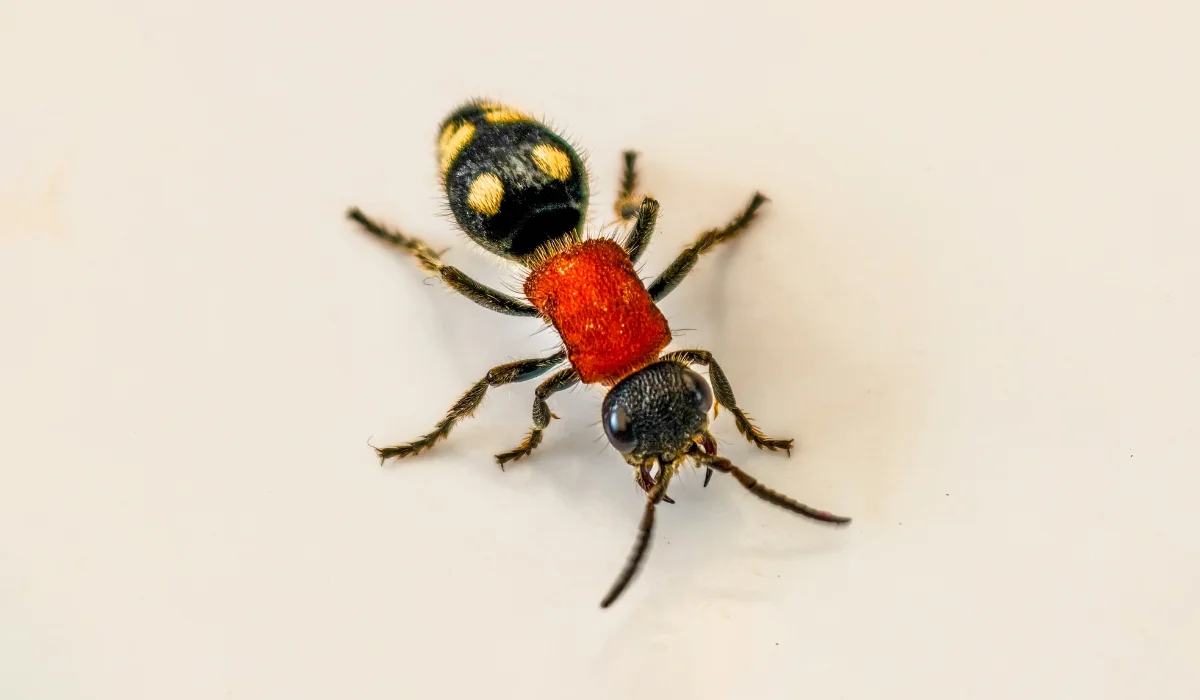
If you searched for velvet ant Louisiana after spotting a fuzzy red and black insect on your driveway, you may be surprised by what you found. A velvet ant is not a true ant. It is a solitary wasp, and the wingless female spends much of her time running across the ground.
That behavior explains why velvet ants in Louisiana often turn up near patios, garages, sidewalks, lawn edges, sheds, and open soil. They normally live outdoors. A velvet ant in your house is more likely to have wandered through an open door or exterior gap than to be part of an indoor infestation.
There is still a good reason to keep your distance. Female velvet ants can sting, and the sting has a reputation for being painful. Understanding where these insects hide, what brings them close to a home, and how they differ from ordinary ants can help you decide whether you are dealing with one stray visitor or recurring activity around your property.
Velvet Ant Louisiana: Where These Wasps Usually Hide
A velvet ant spends most of its time close to the ground. Females search outdoor areas for the nests of other insects, particularly solitary bees and wasps. That search often brings them across bare soil, thin turf, garden edges, and other sunny sections of a yard.
The University of Florida IFAS explains that velvet ants are solitary wasps and that the adult females are wingless. Their young develop in the nests of other insects. That biology helps explain why velvet ant habitat is tied more closely to outdoor soil and host insects than to the inside of a house.
Where Do Velvet Ants Hide Around a House?
South Louisiana homes offer plenty of places where the yard and structure meet. Driveways run beside turf. Covered patios border landscaping. Garages and carports may stay open while you work outside. A female crossing the ground can move through any of those areas without actually living there.
Velvet ants may also slip beneath planters, lawn tools, stored lumber, or other objects sitting close to the ground. These objects can provide brief shelter from heat or disturbance. Finding a velvet ant underneath one does not mean you have found a velvet ant nest.
| Location | Why You May Find a Velvet Ant There |
| Lawn or bare soil | Females search ground level for the nests of host insects |
| Driveway or sidewalk | Open surfaces provide an easy travel route |
| Patio | Patios often sit beside turf, soil, and landscaping |
| Garage or carport | Large openings allow outdoor insects to wander inside |
| Shed | Door and wall gaps connect the structure directly to the yard |
| Door threshold | A wasp traveling along a slab or wall may reach the entrance |
| Landscaping edge | Soil and ground-nesting insects can attract searching females |
| Beneath outdoor items | Objects near the ground can provide temporary cover |
Why a Velvet Ant May End Up Inside Your Home
Seeing a fuzzy red insect on the living room floor can make a homeowner wonder whether more are hiding nearby. Fortunately, a velvet ant infestation does not work like an ant infestation. Velvet ants are solitary wasps, so they do not build large worker colonies behind walls or send trails of workers through kitchens.
Most indoor encounters begin with a simple opening to the outdoors. A garage door left open while unloading groceries or working in the yard can provide an easy route. Worn door sweeps, damaged weather stripping, and gaps around utility lines may also let an insect move from the yard into a protected space.
When One Sighting Becomes a Pattern
One velvet ant in the house near an open doorway is usually an isolated event. Repeated sightings in the same area deserve a closer look, but the first place to investigate is often outside rather than inside the wall.
Check the nearby slab, soil, landscaping, garage opening, and door seals. Watch for ground-nesting bees or ground-nesting wasps entering small holes in the soil. Those insects can provide the host nests that female velvet ants search for, so recurring velvet ant activity may tell you more about conditions in the yard than conditions inside the home.
The location matters too. Finding three insects over time near the same garage threshold gives you a useful inspection point. Finding one velvet ant on a patio in the middle of summer does not carry the same meaning.
How to Identify a Velvet Ant Before You Get Too Close
A female velvet ant can easily fool someone who expects every wingless insect on the ground to be an ant. Many females have a dense, fuzzy appearance with bold red, orange, black, white, or yellow markings. Those colors are useful clues, but they are not enough for a confident identification by themselves.
Male velvet ants look quite different because they have wings. The NC State Extension notes that females are wingless and capable of stinging, while males are winged and cannot sting. This difference is one reason photos can be more useful than relying on a common name alone.
Is It a Red Velvet Ant or a Regular Ant?
The large red and black forms people notice are often called red velvet ants, cow killer ants, or cow killer wasps. “Cow killer” is a nickname tied to the reputation of the female’s painful sting. It should not be taken literally as a description of normal behavior around livestock.
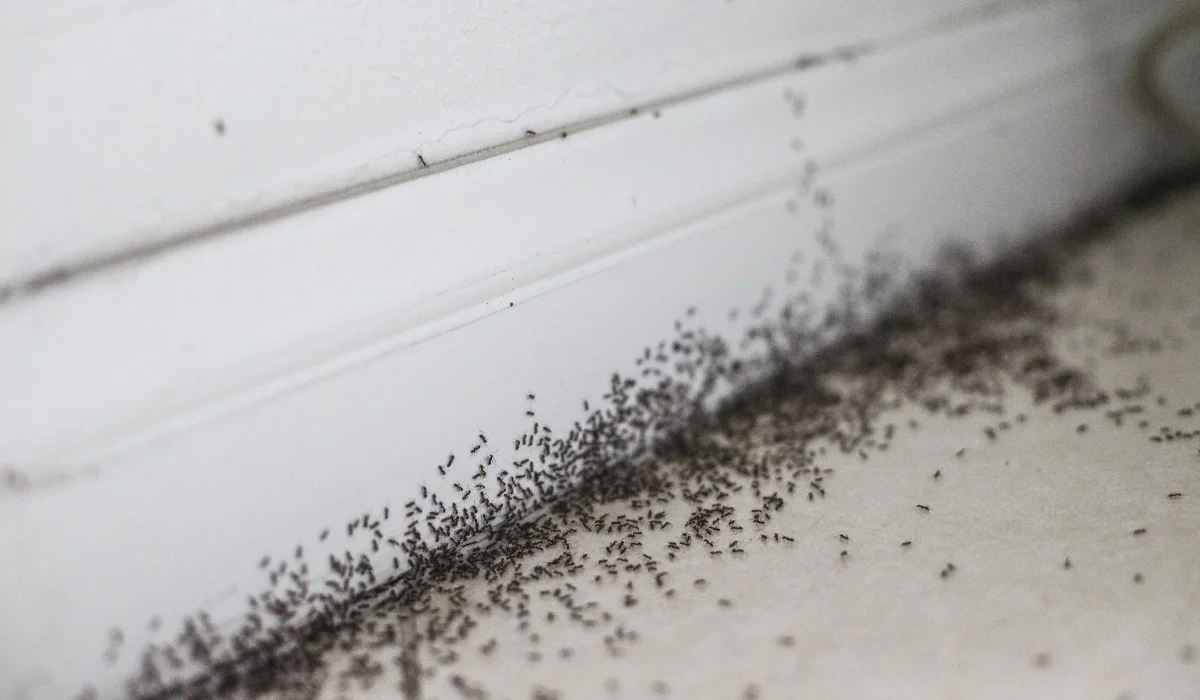
A velvet ant also behaves differently from many household ants. You may see one running alone across the ground rather than following an organized trail with dozens of workers.
| Feature | Female Velvet Ant | Male Velvet Ant | Typical Worker Ant |
| Insect group | Wasp | Wasp | Ant |
| Wings | No | Yes | Usually no |
| Appearance | Often fuzzy and boldly patterned | Varies | Varies by species |
| Can sting? | Yes | No | Depends on species |
| Social colony | No | No | Usually yes |
| Typical movement | Often seen alone on the ground | More often seen flying | Workers may follow trails |
If you are unsure what you found, do not pick it up. A clear photo from several feet away can give a pest professional much more useful information without putting your hand within sting range.
Why Some South Louisiana Yards See More Velvet Ant Activity
Where velvet ants live has a lot to do with the insects they use as hosts. Female velvet ants search for the nests of other solitary bees and wasps, many of which nest in the ground. A yard with suitable host activity gives the female a reason to pass through.
Sunny ground can be especially worth watching. Thin grass, bare soil beside a driveway, lightly vegetated garden edges, and open spots near an outbuilding may support different types of ground-nesting insects. These areas can become part of the route a female searches.
What Repeated Sightings Can Tell You
If you see a velvet ant once, you may never see another. If you notice them repeatedly around one section of the property, start looking for a pattern rather than focusing on individual insects.
Small holes in soil deserve observation from a safe distance. Bees or wasps repeatedly entering and leaving a hole can indicate nesting activity. Do not place your hands near the opening, since different ground-nesting species behave differently when disturbed.
South Louisiana homes also tend to have plenty of semi-open spaces. Porches, sheds, garages, patios, and carports make outdoor insects visible close to living areas. A velvet ant crossing a carport is still behaving like an outdoor insect even though it may be only a few feet from your back door.
| What You Notice | What It May Mean |
| One velvet ant on a driveway | Normal outdoor movement |
| Several sightings near bare soil | Host insect activity may be nearby |
| One inside an open garage | Accidental entry is a reasonable explanation |
| Repeat sightings at the same doorway | Check seals and nearby outdoor activity |
| Bees or wasps entering soil holes | Ground-nesting insects may be present |
Are Velvet Ants Dangerous to People and Pets?
The velvet ant sting is the main reason homeowners should avoid handling these insects. Female velvet ants can sting when they are grabbed, stepped on, pinned against the skin, or otherwise disturbed. The sting is known for causing strong pain.
That does not mean a female velvet ant spends its time looking for people to attack. These are solitary wasps. They are not defending a large worker colony in the way social yellow jackets may defend a nest. Most of the time, the insect you see crossing a sidewalk is trying to continue across the property.
Do Velvet Ants Sting Without Warning?
A female has the physical ability to sting, but simply seeing one does not mean a sting is likely. Problems are more likely when a person or pet makes direct contact. Children may be tempted by the bright colors and fuzzy body, while dogs and cats may try to paw at a fast-moving insect.
Keep children and pets away, and avoid moving the insect with your hands. If someone is stung, monitor the reaction. Trouble breathing, facial or throat swelling, dizziness, or other signs of a severe allergic reaction require prompt medical attention.
Velvet ants are also not structural or stored-food pests. They are not feeding on pantry products, clothing, or the wood framing of your home. Their significance around a house comes from the sting risk and what their presence may tell you about outdoor insect activity.
How to Keep Velvet Ants Outside Your South Louisiana Home
Preventing an indoor velvet ant Louisiana sighting starts where the structure meets the yard. Check door sweeps, weather stripping, garage seals, and openings around pipes or utility lines. If daylight shows beneath an exterior door, an insect traveling at ground level may have enough room to enter.
Keep stored items from building up beside exterior doors and garage walls. A clearer perimeter makes gaps easier to see and gives you a better view of recurring pest activity. If sightings keep happening, also watch nearby soil for solitary bee or wasp activity rather than assuming velvet ants themselves are nesting inside the structure.
When Professional Identification Makes Sense
An occasional outdoor velvet ant does not automatically call for treatment. Repeated sightings, uncertainty about the insect, or activity close to places where children and pets spend time are better reasons to have the property checked.
LaJaunie’s Pest Control technicians inspect exterior doors, windows, garages, cracks, access points, and the base of the home when looking for pest activity. If velvet ants or other Louisiana stinging insects keep appearing around the same part of your property, contact LaJaunie’s Pest Control to have the activity identified and the surrounding area inspected.
The useful goal is not simply to remove the insect you can see. You want to know whether it wandered in once, whether an exterior opening is involved, or whether nearby ground-nesting insects are contributing to repeated activity. That approach gives South Louisiana homeowners a clearer answer without treating every velvet ant sighting like a household ant problem.