



A big bee hovering beside a porch rail can get your attention fast. So can a patch of lawn where small bees seem to appear every time you walk past. With so many bees in Louisiana, figuring out what you are seeing is often harder than deciding whether the insect looks intimidating.
The useful clues are usually simple. A carpenter bee may keep returning to the same wooden beam. Honey bees may create steady traffic at one wall opening. Small native bees may spend most of their time around flowers or just above bare soil.
You do not need to identify every species by sight. The U.S. Geological Survey reports that the United States has more than 4,000 species of native bees. Around a Louisiana home, body shape, nesting location, and behavior usually narrow the possibilities much faster than color alone.
How to Identify Bees in Louisiana
If you are learning how to identify bees in Louisiana, start with the whole insect rather than its stripes. Yellow and black markings appear on bees, wasps, yellow jackets, and insects that simply resemble them, so color can send you in the wrong direction.
Hair is a better clue. Many bees have visibly hairy bodies that help them collect pollen, and some carry yellow or orange pollen on their legs. Where the insect goes next can be just as revealing. Different groups use wood, soil, tree cavities, wall openings, and other sheltered spaces.
| What You Notice | What It May Mean | What to Check Next |
| Fuzzy body with pollen on the legs | Likely a bee | Watch where it goes after feeding |
| Large bee hovering near wood | Possible carpenter bee | Look for a round hole |
| Many bees using one wall opening | Possible social colony | Check for steady two-way traffic |
| Small bees flying low over soil | Possible ground-nesting bees | Look for individual holes |
| Smooth, narrow-bodied insect near food | More likely a wasp or yellow jacket | Check body shape and feeding behavior |
| Metallic green insect on flowers | Possible sweat bee | Watch for pollen-gathering activity |
Try to put two or three clues together. Insects move quickly, colors change in different light, and you may never get a perfect close view. A nest entrance or repeated flight pattern often tells you more than a photograph would.
Common Types of Bees in Louisiana
Louisiana bees, identified
A quick field guide to the bees homeowners notice most around Louisiana properties, sorted by the concern their nesting habits create.
The types of bees in Louisiana that homeowners notice most are usually the ones using gardens, lawns, wooden structures, or cavities around buildings. Some live in organized colonies. Others live independently even when many nests appear in the same small area.
Honey Bees in Louisiana
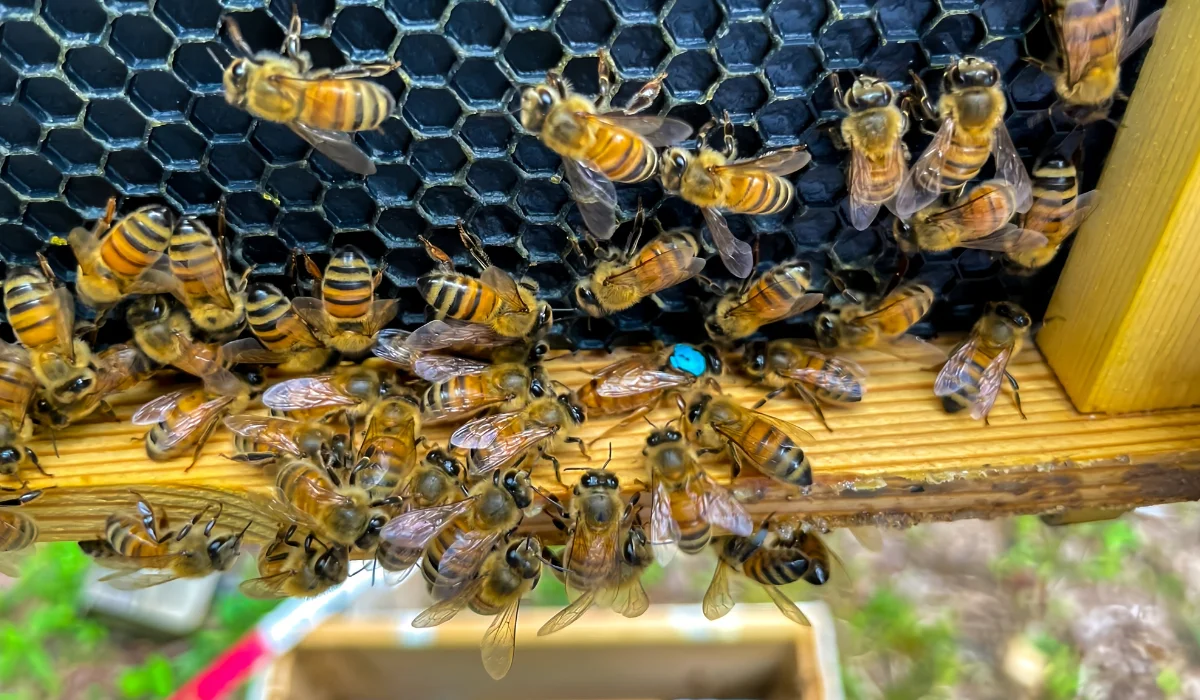
Honey bees in Louisiana usually appear brown or amber with darker bands and visible body hair. Workers move steadily between flowers and the colony, and you may see compact yellow or orange pollen loads on their hind legs.
Their social behavior is one of the strongest identification clues. A few bees on flowering plants may have come from well beyond your property, but a steady stream entering and leaving the same tree or wall opening suggests a colony nearby.
A swarm is different from an established nest. A large cluster resting on a branch, fence, or other surface may stay there temporarily while scout bees look for a suitable cavity.
Carpenter Bees in Louisiana
Carpenter bees in Louisiana are hard to miss once they start inspecting porch rails, decks, fascia boards, sheds, and other wooden features. They are large, heavy-bodied bees with a fuzzy upper body and a smoother, shinier abdomen.
Their nest entrance is even more distinctive. Female carpenter bees excavate galleries in wood, leaving a clean round opening that is commonly about 1/2 inch wide, according to Penn State Extension.
Do not assume every large bee near a deck has built a nest. Repeated entry into the same round opening is a much stronger sign. Fresh activity may also leave coarse wood particles beneath the hole.
Bumble Bees in Louisiana
Bumble bees in Louisiana are also large, but they tend to look fuzzy across more of the body than carpenter bees. Many carry familiar black and yellow markings, although exact patterns vary.
Their nesting habits provide the clearest difference. Bumble bees do not drill clean tunnels into wooden trim. They usually use spaces that already exist, including underground cavities and abandoned animal burrows.
A large, fuzzy bee repeatedly disappearing into the ground therefore points in a different direction from a bee using a hole in a porch beam.
Sweat Bees and Other Native Bees in Louisiana
Sweat bees in Louisiana are much smaller and easier to overlook. Some are dark brown or black, while others have metallic green or blue-green bodies that stand out when sunlight hits them.
You are more likely to notice these small native bees around flowering plants than around siding or rooflines. Some sweat bees also land on people to collect salts from perspiration, which explains their common name.
Their size sometimes causes people to mistake them for flies. Watching whether they move between flowers and collect pollen can help settle the question.
Ground Bees in Louisiana
The phrase ground bees in Louisiana covers many solitary bees that use soil rather than a hive. Their activity can look dramatic when dozens of small holes appear in a lawn or garden bed at the same time.
The USDA Forest Service states that about 70% of native bee species nest in the ground. Many of those species are solitary. Each female maintains her own nest even when suitable soil brings many females into the same patch.
That is why heavy activity over one section of lawn does not always mean you are looking at one large colony.
| Bee Group | Typical Appearance | Common Nest Location | Strong Identification Clue |
| Honey bee | Brown or amber with visible hair | Tree or structural cavity | Many workers using one entrance |
| Carpenter bee | Large, fuzzy thorax, shinier abdomen | Wood | Clean round entrance |
| Bumble bee | Large and densely fuzzy | Existing cavity or underground space | Fuzzy abdomen and ground-level traffic |
| Sweat bee | Small, sometimes metallic | Soil or small cavities | Small size and frequent flower visits |
| Solitary ground bee | Appearance varies | Bare or lightly covered soil | Individual holes close together |
Bees, Wasps, and Yellow Jackets: Key Differences
Many people searching for bee identification are actually looking at a wasp or yellow jacket. The familiar black-and-yellow pattern is not enough to separate them, especially when the insect refuses to stay still.
Many bees look rounder and hairier. Yellow jackets and several common wasps have smoother bodies and a more obvious narrow waist. Visible pollen is another useful clue because bees often carry it on their legs or body.
Behavior around food can help too. Honey bees generally stay focused on flowers and nectar sources. Yellow jackets are much more likely to investigate outdoor meals, sweet drinks, meat, trash cans, and other human food.
| Feature | Many Bees | Yellow Jackets and Many Wasps |
| Body texture | Often visibly hairy | Usually smoother |
| Overall build | Often rounded | Commonly narrow at the waist |
| Pollen | May be visible on legs or body | Usually not carried as a visible load |
| Typical food activity | Flowers, pollen, and nectar | Insects, sweets, meat, and discarded food |
| Nest clues | Soil, wood, or enclosed cavities | Paper nests, underground nests, or structural voids |
The nest itself can settle some cases quickly. Paper wasps build exposed paper combs under sheltered surfaces. Mud daubers build with mud. Carpenter bees leave round openings in wood, while many solitary bees disappear directly into the soil.
Where Bees Build Nests Around Louisiana Homes
For many bees in Louisiana, the nest tells you more than the insect’s color. Watching from a comfortable distance for a few minutes can show whether bees are simply feeding or returning to one exact location.
Around Porches, Walls, and Wood
Porch rails, fence posts, fascia boards, sheds, decks, and exposed trim deserve a closer look when large bees keep returning. A neat round opening in wood is a strong carpenter bee clue, particularly when you see repeated entry and exit.
Wall and soffit openings require a different kind of observation. Steady traffic through one crack or gap suggests that insects are using the structure. It is better to identify them before closing the opening because different stinging insects require different responses.
Around Lawns and Gardens
Bare soil, thin turf, and open areas in garden beds can support solitary ground-nesting bees. The first thing you notice may be low flight over the area rather than the nest openings themselves.
Flowers tell you less about where a nest is located. Bees can travel into your yard simply to feed, so a busy flower bed may reflect healthy pollinator activity rather than a nest beside the house.
| Where You See Activity | What to Look For | Possible Explanation |
| Porch rail or wooden trim | Round hole with repeated traffic | Carpenter bee activity |
| Wall or soffit opening | Many insects entering and leaving | Nest inside a cavity |
| Bare patch of soil | Several small holes and low flight | Solitary ground-nesting bees |
| Existing underground opening | Large fuzzy bees using one entrance | Possible bumble bee nest |
| Flower bed | Bees moving from bloom to bloom | Normal foraging activity |
When Bee Activity Needs Attention
Most common bees in Louisiana do not create a property problem simply by visiting flowers. The situation changes when insects begin using structural wood, entering a building, or nesting directly beside a doorway, patio, play space, or another area people use regularly.
Carpenter bee galleries are worth watching because females excavate the wood itself. Wall activity can also be difficult to assess from the outside, especially when the opening is small or high above the ground.
Do not plug an active hole just because insects are using it. If bees or wasps are inside a wall or another enclosed space, blocking their usual entrance can trap them or push them toward another exit.
Uncertain identification is another good reason to avoid disturbing the site. Bees, wasps, and yellow jackets can share similar colors while nesting and behaving very differently.
Choosing the Right Response to Bees in Louisiana
The quickest way to make sense of bees in Louisiana is to connect what the insect looks like with what it is doing. A clean round hole in wood suggests carpenter bees. Heavy traffic through a wall opening suggests insects are using the structure. Small bees over exposed soil may each be tending separate nests, while bees moving calmly through flowers may only be feeding.
Correct identification keeps ordinary pollinator activity from becoming an unnecessary pest-control job. It also helps you recognize the situations that do need attention, such as wood nesting, activity inside structural openings, or nests positioned where people regularly pass.
For carpenter bees, non-honey bees, wasps, and yellow jackets, LaJaunie’s Pest Control can inspect the activity and identify what is using the area before treatment begins. That is useful when a nest is high on an eave, inside a structural opening, or difficult to identify from the ground. If repeated stinging-insect activity around your Southeast Louisiana home has you guessing, contact LaJaunie’s Pest Control for an inspection and a clear recommendation on what should happen next.