



Brown recluse spiders do live in Louisiana, but homeowners identify them more often than they actually encounter them. Southern house spiders, wolf spiders, and other brown spiders can look similar at a glance, which makes careful identification important before assuming you have a recluse problem. LaJaunie’s guidance reflects what technicians see during service calls: suspected brown recluses often require a closer look because several spiders around Louisiana homes share similar coloring, while true recluses favor quiet, undisturbed spaces rather than exposed areas.
Key Takeaways
- Brown recluse spiders occur in Louisiana, but many suspected sightings turn out to be other brown spiders.
- Identification should rely on several features, including body shape, eye arrangement, markings, and where the spider was found, rather than color alone.
- Brown recluses favor quiet, protected spaces, so reducing clutter and checking stored items can lower the chance of an accidental encounter.
Are Brown Recluse Spiders Common in Louisiana?
Brown recluse spiders, Loxosceles reclusa, occur in Louisiana and other parts of the south-central United States. Their presence in the state does not mean they are common in every neighborhood, parish, or home.
Homeowners often become concerned after finding any tan or brown spider indoors. Louisiana has many common house spiders with overlapping colors and body shapes, so a brown spider on a wall or garage floor should not automatically be identified as a recluse.
LaJaunie’s existing guidance notes that true brown recluse sightings are less common than many homeowners expect. Southern house spiders and wolf spiders are among the spiders that can cause confusion, which is why identification should come before treatment.
Louisiana’s long warm season supports a wide range of insects and spiders. That can mean more spider activity around homes in general without making every brown spider a brown recluse.
How to Identify a Brown Recluse Spider in Louisiana
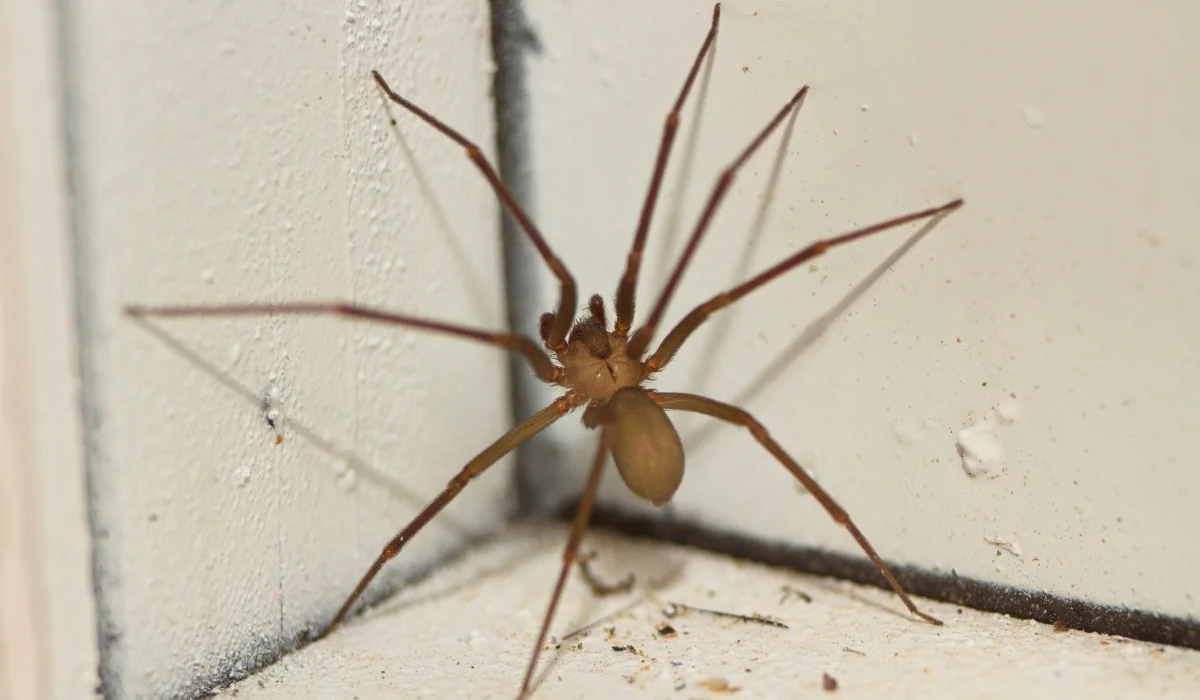
A brown recluse is usually light tan to medium brown with relatively plain coloring. Adults are roughly 1/4 to 1/2 inch long in body length, not including the legs.
The well-known violin-shaped marking can help with identification, but it should not be the only feature you use. Lighting, body color, and natural markings on unrelated spiders can make other species appear similar at a quick glance.
Brown recluses also have six eyes arranged in three pairs. Most spiders have eight eyes, although eye counting is not a practical way for a homeowner to identify a live spider from close range.
Their legs are relatively uniform in color and lack the heavy spines or obvious banding seen on some other spiders. The broader range of brown spiders found in Louisiana shows why several physical traits need to be considered together.
Size can also be misleading. A fast-moving huntsman spider may look alarming because of its leg span, while a small brown recluse can be much less noticeable. Neither size nor speed alone tells you whether a spider is medically significant.
Brown Recluse vs. Southern House Spider
The southern house spider is one of the most useful comparisons for Louisiana homeowners because males can be mistaken for brown recluses. The two spiders differ in appearance, behavior, and the places where their silk is commonly found.
| Feature | Brown Recluse | Southern House Spider |
|---|---|---|
| Scientific Name | Loxosceles reclusa | Kukulcania hibernalis |
| General Color | Tan to medium brown | Brown to gray; males may appear lighter |
| Eyes | Six eyes arranged in three pairs | Eight eyes |
| Marking | May have a darker violin-shaped marking | Does not have the true recluse violin pattern |
| Web Use | Builds an irregular retreat in secluded areas | Often builds woolly, irregular webs around cracks and crevices |
| Common Locations | Boxes, closets, attics, storage areas, undisturbed belongings | Window frames, eaves, wall gaps, garages, and exterior crevices |
| Medical Concern | Bites can cause medically significant reactions | Not considered medically significant in the same way |
| Typical Confusion | Mistaken for several brown spiders | Males are commonly mistaken for brown recluses |
The differences become easier to recognize when you compare a southern house spider with a brown recluse. A spider beside a woolly web around a window frame, for example, points toward a different identification than one found deep inside a long-undisturbed cardboard box.
Avoid handling a spider simply to check its eyes or markings. If identification matters, a clear photo taken from a comfortable distance is more useful than trying to examine a live spider up close.
Where Brown Recluse Spiders Hide in Louisiana Homes
Brown recluse spiders favor areas that stay quiet for long periods. Attics, closets, garages, storage rooms, crawl spaces, sheds, cardboard boxes, and stacks of seldom-used belongings can all provide the shelter they prefer.
Inside these areas, they may hide beneath boxes, behind stored furniture, inside shoes, or among folded clothing that has not been moved recently. Accidental bites are more likely when a spider becomes pressed against the skin inside clothing, bedding, shoes, or stored materials.
Louisiana’s humid climate does not mean brown recluses prefer wet, exposed spaces. Inside a house or outbuilding, protected storage areas can provide relatively dry, stable conditions even when outdoor conditions are hot and humid.
This applies across South Louisiana. Homes in Lafourche and Terrebonne parishes around Thibodaux and Houma can have garages, raised areas, sheds, and storage spaces just as homes in Orleans, Jefferson, and St. Tammany parishes do. The parish itself does not identify the spider, so the specimen and specific hiding place matter more than the ZIP code.
Outdoor spiders can add to the confusion because Louisiana supports many large and noticeable species. Banana spiders found around Louisiana homes and yards build exposed webs and behave very differently from the reclusive indoor habits associated with brown recluses.
What LaJaunie’s Technicians Look for During Spider Service
When technicians evaluate spider activity, they do not rely on one web or one brown spider to reach a conclusion. LaJaunie’s standard service process includes inspecting exterior walkways, windows, the base of the home, attics, and garages when accessible, along with checking for current and potential pest activity.
That wider inspection helps because many spider problems are connected to shelter and prey rather than one individual spider. Cracks, cluttered storage areas, garage gaps, exterior lighting, and insect activity can all influence where spiders remain around a home.
LaJaunie’s technicians also remove accessible webbing from first- and second-story areas up to 25 feet as part of the standard service process. Web removal helps clean up active areas, but correct identification and attention to the surrounding conditions matter more when a homeowner suspects a brown recluse.
The same approach applies when the spider is very small. A tiny black spider can be difficult to identify from color alone, just as an unidentified brown spider should not be labeled a recluse without looking at several characteristics.
Signs You May Have Brown Recluse Spiders
Brown recluse spiders are secretive, so a large web across an open doorway is not the type of sign that normally points toward them. More useful evidence comes from finding spiders or related material repeatedly in quiet, protected locations.
Repeated Spider Sightings in Secluded Areas
Finding one unidentified brown spider does not confirm an infestation. Repeated sightings in boxes, closets, attics, storage rooms, or other undisturbed spaces deserve more attention.
Keep track of where the spiders appear rather than immediately disposing of every specimen without looking. Photos or a safely contained specimen can make professional identification easier.
Small Irregular Retreat Webs
Brown recluses do not build the large orb webs people often notice outdoors. Their silk is generally associated with sheltered retreats rather than an exposed web designed to catch flying insects.
An irregular web by itself still cannot identify the spider. Southern house spiders and several other spiders also create messy-looking silk around protected spaces.
Shed Skins or Egg Sacs
Spider molts and egg sacs can indicate that spiders have been living in an area for some time. However, these signs are not unique enough to confirm brown recluse activity without the spider itself.
If you repeatedly find egg sacs, shed skins, and similar-looking spiders in the same undisturbed area, professional identification becomes more useful. That combination provides more context than a single abandoned web.
Brown Recluse Bites and Health Risks
Brown recluse bites can range from mild local irritation to more serious reactions. Some bites cause pain, redness, swelling, or blistering, while a smaller portion can lead to tissue damage.
Bites often occur when the spider is trapped against the skin rather than because the spider actively approaches a person. Putting on clothing or shoes that have been stored for a long time is one example of how accidental contact can happen.
A skin lesion alone cannot confirm that a brown recluse caused it. Spider bite pictures can show how reactions may look, but photographs cannot prove which spider, insect, infection, or skin condition caused a mark.
The same caution applies to suspected yellow sac spider bites. Different bite-like reactions can resemble one another, especially when the spider was never seen.
If you believe a brown recluse bit you, wash the area with soap and water and use a cool compress. The expected duration of a suspected spider bite varies with the cause and severity, so worsening pain, spreading redness, blistering, fever, or other concerning symptoms should be evaluated by a medical professional.
Other Spiders Louisiana Homeowners May Confuse With Brown Recluses
Southern house spiders are not the only source of confusion. Wolf spiders, nursery web spiders, fishing spiders, huntsman spiders, and other brown or gray spiders can look alarming when they appear indoors.
Wolf spiders tend to have sturdier bodies and more visible patterning than a brown recluse. They are active hunters and may be seen moving across floors rather than remaining hidden in a silk retreat.
Southern house spiders are especially relevant because males have long legs and a brown body that can resemble a recluse at a quick glance. Their association with crevices and woolly webbing around structures provides another clue.
Some spiders are confused with brown recluses simply because homeowners do not recognize them. Comparing the spider with other common Louisiana house spiders can narrow down likely look-alikes without relying on color alone.
How Louisiana’s Climate Affects Spider Activity
Louisiana’s warm temperatures and long insect season support spider activity for much of the year. Spiders follow their food, so homes with abundant insects around exterior lights, doors, windows, garages, and vegetation can see more spider activity in general.
Heavy rainfall and humidity can influence where insects and spiders seek shelter. Garages, sheds, attics, crawl spaces, and storage areas may provide more stable conditions than exposed outdoor locations.
For brown recluses, the key factor is often undisturbed shelter rather than Louisiana humidity itself. A cardboard box that sits untouched in a dry storage room can provide a more suitable hiding place than an exposed damp area outside.
That distinction matters because reducing moisture alone will not solve every spider concern. Storage habits, clutter, entry points, insect activity, and how often an area is disturbed all play a role.
How to Reduce Brown Recluse Hiding Places
Start with storage areas that remain untouched for long periods. Replace damaged cardboard boxes when practical, keep belongings organized, and avoid leaving clothing or shoes undisturbed on garage or closet floors.
Shake out shoes, gloves, seasonal clothing, and other stored items before putting them on. This habit is especially useful for belongings stored in sheds, garages, attics, or closets.
Reduce clutter along walls and in corners so you can see and clean those areas more easily. Vacuuming behind stored furniture and around baseboards can remove webs, egg sacs, shed skins, and insects that spiders may feed on.
Seal practical gaps around windows, doors, utility openings, and other entry points. Reducing insect activity around the home also removes part of the food supply that draws spiders into favorable hunting areas.
When Brown Recluse Activity Needs Professional Spider Control
Professional identification becomes more useful when you are seeing multiple similar spiders, repeatedly finding them in storage areas, or cannot confidently tell a brown recluse from a southern house spider or another look-alike.
A spider inspection should look beyond the individual specimen. The technician can evaluate where spiders are appearing, where insects are active, which hiding spaces are available, and whether cracks or other access points are contributing to the problem.
LaJaunie’s spider control service includes inspection and treatment of spider activity around the home. Service can also include checks of attics and garages, attention to access points and crevices, and removal of accessible exterior webbing.
If you find a spider you suspect is a brown recluse, avoid handling it with bare hands. A clear photo or safely contained specimen can help with identification before the next step is decided.
Making the Right Choice for Brown Recluse Control in Louisiana
Brown recluse spiders are present in Louisiana, but that does not mean every brown spider in a Baton Rouge, New Orleans, Houma, Thibodaux, or Northshore home is a recluse. Southern house spiders and other common species can look similar, so identification should come before unnecessary treatment.
Focus on the combination of physical features, hiding location, repeated sightings, and other evidence around the home. Keeping storage areas organized, checking seldom-used belongings, reducing insects, and closing practical entry points can also reduce the places spiders use.
If you are repeatedly finding suspicious spiders or want help confirming what species is in your home, LaJaunie’s spider control team can inspect the property, identify the activity, and recommend the appropriate next step.
FAQs About Brown Recluse Spiders in Louisiana
Are Brown Recluse Spiders Common in Louisiana?
Brown recluse spiders do occur in Louisiana, but homeowners often mistake other brown spiders for them. Southern house spiders and wolf spiders are two common sources of confusion. Finding a brown spider indoors does not confirm a recluse, so several identification features should be considered together.
How Can You Tell a Brown Recluse From a Southern House Spider?
Brown recluses have six eyes arranged in three pairs and may have a darker violin-shaped marking. Southern house spiders have eight eyes and often build woolly webs around cracks, windows, or exterior crevices. Male southern house spiders are among the spiders most commonly mistaken for brown recluses.
What Should I Do If I Find a Brown Recluse in My House?
Avoid picking it up with bare hands. If you can do so without getting close, take a clear photo or safely contain the spider for identification. Then check nearby storage areas for additional activity. Repeated sightings or a confirmed brown recluse are good reasons to have the area professionally inspected.